A few years ago, artificial intelligence and Bitcoin felt like two completely different conversations.
Bitcoin belonged to the world of cryptocurrency, blockchain, mining, wallets, and digital money.
AI belonged to another world—machine learning, automation, data science, and intelligent software.
In 2026, those worlds are increasingly meeting.
And that’s where things become interesting.
Imagine waking up in the morning, making a cup of coffee, and instead of opening several crypto websites, charts, news feeds, and blockchain dashboards, you simply ask an AI assistant:
“What happened to Bitcoin while I was sleeping?”
Within moments, the system could potentially summarize overnight price movements, important news, changes in volatility, unusual blockchain activity, and broader market sentiment.
That’s useful.
But now imagine asking:
“Will Bitcoin go up today?”
That’s where we need to slow down.
Artificial intelligence can analyze information remarkably well, but it cannot see the future.
That distinction is at the heart of this article.
The real story of AI and Bitcoin in 2026 isn’t about a magical machine that tells us when to buy and sell.
It’s about how artificial intelligence can help ordinary people, researchers, developers, traders, miners, and financial institutions understand an increasingly complicated digital economy.
Let’s look at nine areas where that transformation is already becoming visible.
1. AI Is Making Bitcoin Research Less Overwhelming
If you’ve ever tried to research Bitcoin seriously, you probably know the feeling.
You open a price chart.
Then another tab for financial news.
Then you check trading volume.
Then perhaps a blockchain analytics website.
Five minutes later, your browser has fifteen tabs open and you aren’t sure which one you started with.
Bitcoin generates an extraordinary amount of information because the market operates 24 hours a day, seven days a week.
AI can help organize that information.
An intelligent research system could potentially analyze price movements, trading volume, volatility, blockchain activity, economic developments, financial news, and market sentiment at the same time.
Instead of replacing the researcher, AI can act almost like a research assistant.
Think about the difference.
A bad use of AI would be:
“Tell me exactly what Bitcoin will do tomorrow.”
A better use would be:
“Summarize today’s major Bitcoin developments and show me the arguments for both bullish and bearish scenarios.”
The second question encourages research rather than blind prediction.
And that’s where AI becomes genuinely useful.
It doesn’t need to know the future to save us hours of work.
2. AI Can Help Us Make Sense of Blockchain Data
One of the fascinating things about Bitcoin is that its blockchain is public.
Transactions leave a digital trail.
Researchers can study transaction activity, network usage, fees, wallet movements, and many other indicators.
But there’s a problem.
There is a lot of data.
Imagine looking at thousands—or millions—of blockchain transactions and trying to identify unusual patterns manually.
That’s exactly the type of job computers are good at.
Machine-learning systems can search huge datasets for patterns that deserve attention.
Suppose an AI analytics system notices unusual activity among a group of wallets.
That doesn’t automatically mean:
“Bitcoin is about to crash!”
It simply means:
“Something unusual is happening here. You may want to investigate.”
That difference matters.
Sometimes people see a large Bitcoin transfer and immediately assume somebody is preparing to sell.
But there may be several explanations.
AI can help identify the signal.
Humans still need to interpret the story behind it.
3. AI Could Become a Powerful Ally Against Crypto Scams
Unfortunately, wherever money goes, scams tend to follow.
Crypto is no exception.
Most of us have probably seen some version of the message:
“Guaranteed crypto profits!”
“Earn huge returns every day!”
“Our AI trading system never loses!”
Those claims should immediately make you cautious.
Artificial intelligence can potentially help identify suspicious behavior by analyzing scam language, abnormal transactions, phishing attempts, suspicious websites, and unusual account activity.
Imagine receiving an email that looks almost exactly like a message from a cryptocurrency exchange.
The logo looks correct.
The language sounds professional.
There’s even a warning telling you that your account will be suspended unless you act immediately.
An AI-powered security system might compare that message against known phishing patterns and warn you before you click.
That’s valuable.
But here’s the uncomfortable part:
Scammers have AI too.
They can use generative AI to write more convincing emails, create realistic voices, produce fake videos, and automate fraudulent conversations.
So AI may become both the shield and the sword.
Technology will help, but common sense will remain one of our strongest defenses.
Never give anyone your seed phrase.
Never send cryptocurrency simply because somebody creates a sense of urgency.
And be deeply skeptical of guaranteed returns.
4. AI Trading Tools Are Becoming Easier to Use
Algorithmic trading used to sound like something reserved for Wall Street firms and professional programmers.
That’s changing.
Today, AI can help ordinary users explore market data without requiring them to write thousands of lines of code.
You might ask an AI system to examine momentum, volatility, moving averages, trading volume, or market sentiment.
It could help identify situations that deserve further investigation.
This accessibility is exciting.
It’s also dangerous if misunderstood.
Here’s a simple truth worth remembering:
A bad trading strategy doesn’t become a good strategy just because AI executes it.
Imagine giving a robot terrible driving directions.
The robot may follow those directions perfectly.
You’ll simply arrive at the wrong destination more efficiently.
Trading automation works the same way.
If the underlying strategy is poor, automation doesn’t magically fix it.
That’s why testing matters.
Backtesting, paper trading, small position sizes, and sensible loss limits may not sound as exciting as “AI-powered profits,” but they are far more important.
5. AI Agents Could Become Digital Financial Assistants
AI agents are one of the most fascinating developments to watch.
Think of an ordinary chatbot as something you ask questions.
An AI agent goes further.
You give it a goal, and it can potentially perform several connected tasks.
Imagine saying:
“Watch my Bitcoin portfolio and tell me when something important changes.”
The agent might monitor market volatility, Bitcoin news, blockchain activity, and your predefined risk limits.
If something unusual occurs, it alerts you.
That sounds useful.
Now take the idea one step further.
What if you allow the AI agent to move money?
Suddenly, the situation becomes much more serious.
What happens if it misunderstands an instruction?
What happens if a malicious website tricks the agent?
What happens if the software makes a technically correct decision that you never intended?
This is why I believe the most sensible near-term model is:
AI recommends. Human approves.
At least for important financial decisions.
Giving software unlimited financial authority simply because it is intelligent would be a very different level of risk.
6. AI Is Changing the Cybersecurity Battle
Crypto security can be unforgiving.
If somebody steals your credit card, there are established processes for reporting fraud.
Cryptocurrency can be different.
A blockchain transaction may be irreversible.
Once digital assets leave your wallet, getting them back can be extremely difficult.
AI can help security systems detect unusual behavior.
Suppose you normally access your wallet from the same devices and follow predictable transaction patterns.
Suddenly, there’s an unusual login followed by an unusually large transfer request.
An intelligent security system might recognize that the behavior doesn’t look normal and request additional verification.
That’s the good side.
The bad side is that attackers are becoming more sophisticated too.
Imagine receiving a phone call that sounds exactly like someone you know.
Or seeing a convincing video of a famous businessperson apparently promoting a cryptocurrency opportunity.
Deepfakes make the old advice—”I saw it with my own eyes”—less reliable than it once was.
In the AI era, verification matters more than appearance.
7. AI Is Making Bitcoin Easier to Learn
This may be one of the most underrated benefits.
Think back to the first time you encountered words such as:
Hash rate.
Private key.
Cold wallet.
Mining difficulty.
UTXO.
Layer 2.
If you were confused, you weren’t alone.
Crypto has a language of its own.
AI can act like a patient tutor.
You can ask:
“Explain Bitcoin mining to me like I’m a beginner.”
Then:
“I understand that. Now explain mining difficulty.”
Then:
“Give me an everyday example.”
Traditional educational material doesn’t always adapt to the reader.
AI can.
That could help millions of people understand technology that previously felt inaccessible.
Of course, AI can make mistakes.
Important information should still be verified.
But as an educational companion, its potential is enormous.
8. AI Could Help Financial Institutions Manage Bitcoin Risk
Imagine you’re responsible for risk management at a large financial institution.
You don’t simply ask:
“Will Bitcoin go up?”
Your questions are much less exciting—and much more important.
How much exposure do we have?
What happens if volatility suddenly doubles?
How liquid is the market?
Are there unusual transactions?
What are our cybersecurity risks?
Are there regulatory concerns?
AI can help organize these enormous datasets.
It can identify anomalies and help risk teams focus their attention.
But even large institutions face the same fundamental problem as individual users:
AI can be wrong.
A model trained on yesterday’s market may struggle with tomorrow’s completely new environment.
That’s why responsible AI isn’t simply about building smarter algorithms.
It’s also about knowing when not to trust them.
9. AI and Bitcoin Could Create an Entirely New Digital Economy
Now we reach the most futuristic part.
Imagine AI agents that don’t simply answer questions but actually participate in the digital economy.
An autonomous agent might purchase cloud computing, pay for online services, manage subscriptions, negotiate with another software agent, or pay for data.
Machines could effectively become economic participants.
That raises a fascinating question:
What kind of money would machines use?
Bitcoin and other digital payment technologies become interesting in that context because software can potentially interact with them directly.
But this future creates enormous questions.
Who owns the AI agent’s money?
Who is responsible for its mistakes?
How much is it allowed to spend?
Can it enter agreements?
What happens if somebody hacks it?
The technology may arrive before society has complete answers.
And that is precisely why this area deserves serious attention.
What About Bitcoin Mining and AI?
Bitcoin mining is another interesting area.
Large mining operations must manage electricity consumption, equipment temperatures, cooling, maintenance, and hardware performance.
AI may help optimize some of those operations.
For example, imagine thousands of mining machines operating continuously.
Instead of waiting for equipment to fail, an AI system could analyze performance data and detect signs that a particular machine may need maintenance.
That’s known as predictive maintenance.
AI could also help operators study energy consumption and cooling efficiency.
But let’s clear up one misconception.
AI doesn’t replace Bitcoin’s proof-of-work mechanism.
Bitcoin mining still depends on the rules of the Bitcoin network.
AI can potentially help optimize the surrounding operation.
That’s very different from saying that AI “mines Bitcoin automatically.”
Whenever you see a company using phrases such as AI mining, look beyond the marketing language and find out what the technology actually does.
AI-Powered On-Chain Research
Price tells us one story.
Blockchain activity can tell us another.
On-chain research examines data associated with blockchain activity to better understand what’s happening within the network.
AI could help researchers identify unusual changes in this data.
Imagine receiving an alert:
“This network metric has moved significantly outside its normal recent range.”
That’s useful.
But notice what the AI didn’t say.
It didn’t say:
“Buy Bitcoin immediately.”
The alert becomes the beginning of the investigation, not the end.
That’s the mindset readers should develop when using AI for financial research.
AI finds the interesting question.
We still need to investigate the answer.
Don’t Forget About Privacy
There’s another issue that receives far less attention than it deserves.
Privacy.
As AI assistants become more useful, people naturally want to give them more information.
That can become dangerous when financial credentials are involved.
Your private key is private for a reason.
Your seed phrase is not something an AI assistant needs.
Neither are your passwords or authentication codes.
If an unfamiliar AI service says:
“Enter your wallet recovery phrase so our AI can optimize your portfolio,”
stop.
A legitimate educational tool can explain Bitcoin perfectly well without controlling your wallet.
Convenience should never make us careless with financial security.
Regulation Will Become Increasingly Important
AI is evolving quickly.
Crypto is evolving quickly.
Regulation often moves more slowly.
Put those three facts together and you can see the challenge.
A company using AI to summarize Bitcoin news is very different from a company using AI to automatically trade customer funds.
The risks aren’t the same.
The responsibilities aren’t the same.
The rules may not be the same either.
As AI agents become capable of performing financial tasks, governments and regulators will have to address increasingly complicated questions involving accountability, consumer protection, privacy, disclosure, and automated decision-making.
For readers, there’s a simple lesson.
A professional-looking website isn’t proof that a financial service is trustworthy.
Neither is the word AI.
Verify important claims independently.
How I Would Use AI for Bitcoin Research
If I were researching Bitcoin with AI, I wouldn’t begin with:
“Tell me whether I should buy Bitcoin.”
I’d start with questions.
What’s happening in the market?
What are the strongest arguments on both sides?
What risks am I overlooking?
What information would prove my current assumption wrong?
What sources should I verify?
That last question is particularly important.
AI becomes more powerful when we use it to challenge our thinking.
Suppose you’re convinced Bitcoin is about to rise.
Don’t ask AI to confirm your belief.
Ask:
“Give me the strongest evidence that my assumption could be wrong.”
Now AI isn’t simply agreeing with you.
It’s helping you think.
That may ultimately be more valuable than any price prediction.
Can AI Really Predict Bitcoin?
We eventually arrive at the question everyone wants answered.
Can AI predict Bitcoin?
It can forecast.
It can model probabilities.
It can analyze historical relationships.
It can identify patterns.
But it cannot know the future.
Imagine the most sophisticated Bitcoin model in the world.
Now imagine that tomorrow morning an unexpected event changes global financial markets.
The model couldn’t have known the event in advance.
Markets aren’t controlled laboratory experiments.
They’re influenced by people, governments, businesses, technology, fear, greed, accidents, innovation, and sometimes pure surprise.
AI may make forecasting better.
It cannot make uncertainty disappear.
The Danger of Trusting a Confident Machine
There’s something strangely persuasive about a confident AI answer.
It can sound calm.
Logical.
Precise.
Authoritative.
And still be wrong.
That’s why the most important skill in the AI era may not be knowing how to ask a machine questions.
It may be knowing when to question the machine’s answers.
Before acting on financial information generated by AI, ask yourself:
Where did this information come from?
Is it current?
Can I verify it?
What assumptions are being made?
What happens if the conclusion is completely wrong?
If losing money would seriously hurt you, confidence from an algorithm isn’t enough.
Opportunity Without the Hype
AI and Bitcoin are genuinely exciting technologies.
We don’t need exaggerated promises to make them interesting.
AI can help us research faster.
It can help us understand blockchain activity.
It can strengthen cybersecurity.
It can improve education.
It can identify suspicious behavior.
It can help manage enormous datasets.
And AI agents may eventually participate directly in digital economies.
Those developments are fascinating on their own.
But Bitcoin remains volatile.
AI remains imperfect.
Scammers remain creative.
And uncertainty remains part of financial markets.
The sensible approach is curiosity combined with caution.
Explore.
Learn.
Experiment.
Verify.
Protect yourself.
And never mistake sophisticated technology for guaranteed financial success.
Frequently Asked Questions
1. What is the relationship between AI and Bitcoin?
Bitcoin doesn’t need artificial intelligence to operate. AI can, however, help people analyze Bitcoin markets, blockchain activity, cybersecurity threats, financial information, and other data connected with the Bitcoin ecosystem.
2. Can AI predict Bitcoin’s price?
Not with certainty. AI can analyze patterns and probabilities, but unexpected economic, regulatory, technological, and market events can quickly change Bitcoin’s direction.
3. Can AI guarantee Bitcoin trading profits?
No. Any service claiming guaranteed AI-powered trading profits should be approached very cautiously. Financial markets always involve uncertainty.
4. Are AI Bitcoin trading bots safe?
They can be useful tools, but they introduce market, software, automation, exchange, and strategy risks. Automation doesn’t eliminate the possibility of losses.
5. Can beginners use AI to learn Bitcoin?
Absolutely. Education may actually be one of AI’s best crypto applications. Beginners can ask follow-up questions and request simpler explanations until a concept makes sense.
6. Can AI identify cryptocurrency scams?
AI can help detect suspicious language, phishing attempts, unusual behavior, and transaction patterns. It cannot identify every scam, so human caution remains necessary.
7. What is an AI crypto agent?
An AI agent is software capable of completing multiple connected tasks toward a goal. In crypto, agents could potentially monitor markets, analyze portfolios, issue alerts, or interact with digital applications.
8. Should I allow an AI agent to control my Bitcoin?
Giving autonomous software control over valuable assets creates significant security risks. For many users, keeping human approval for important transactions is the more cautious approach.
9. Can AI improve Bitcoin mining?
AI may help mining operations optimize equipment maintenance, energy use, cooling, and performance monitoring. It doesn’t replace Bitcoin’s proof-of-work consensus mechanism.
10. What is AI-powered on-chain analysis?
It involves applying AI or machine-learning techniques to blockchain-derived data to help identify patterns, anomalies, or changes worthy of further investigation.
11. Can AI improve cryptocurrency cybersecurity?
Yes. AI can assist with phishing detection, behavioral monitoring, fraud detection, and identifying unusual activity. Attackers can also use AI, however, so cybersecurity remains an ongoing challenge.
Never provide private keys, seed phrases, passwords, or authentication codes to an AI tool. Be cautious about sharing other sensitive financial information as well.
13. Will AI replace Bitcoin traders?
AI will probably automate more research and execution tasks, but human judgment remains important for strategy, risk management, oversight, and unusual situations.
14. Will AI and Bitcoin become more connected?
Quite possibly. AI agents, blockchain analytics, cybersecurity, digital payments, automated research, and financial applications provide several areas where the technologies could increasingly overlap.
15. What is the most important rule when using AI for Bitcoin research?
Use AI to improve your questions and research—not to replace your judgment.
Final Thoughts
So, where does all of this leave us?
AI and Bitcoin in 2026 aren’t simply two fashionable technologies placed in the same headline.
There’s a real connection developing between them.
AI can help people make sense of enormous amounts of Bitcoin and blockchain information.
It can make education easier.
It can identify patterns humans might overlook.
It can help detect suspicious behavior.
It can strengthen certain areas of cybersecurity.
And AI agents may eventually interact with digital financial systems in ways that seem futuristic today.
But there’s one thing I’d encourage every reader to remember.
Don’t hand your judgment over to the machine.
Use AI as an assistant.
Ask it questions.
Challenge its answers.
Verify important information.
Let it help you explore ideas you may have missed.
But when your money, security, or financial future is involved, you remain responsible for the final decision.
Perhaps the most interesting future isn’t one where AI replaces us.
It’s one where humans become better informed because we learn how to use AI wisely.
And that may ultimately be the most powerful connection between artificial intelligence, Bitcoin, and the future of digital finance.
Educational Disclaimer
This article is for educational and informational purposes only. It isn’t financial, investment, trading, legal, or tax advice. Bitcoin and other digital assets can be highly volatile and may result in substantial financial losses. AI models, trading algorithms, forecasts, and historical analysis cannot guarantee future results. Always conduct independent research and consider consulting appropriately qualified professionals before making financial decisions.
About BitVoltAI
BitVoltAI explores artificial intelligence, Bitcoin, blockchain, AI agents, cybersecurity, digital finance, and emerging technology with one simple objective: making complicated ideas easier for everyday readers to understand.
- AI in Cryptocurrency: 7 Powerful Ways AI Transforms Blockchain
- AI and Bitcoin in 2026: 9 Powerful Ways Artificial Intelligence Is Transforming Digital Finance
- ⚡ AI Energy Grids in 2026: The Intelligent Infrastructure Race That Could Decide the Future of Civilization
- 🚀 Quantum AI and Cryptocurrency: The Future of Smart Digital Investing in 2026
- 📘 AI Cryptocurrency Trading: A Complete Educational Guide (2026)
Table of Contents
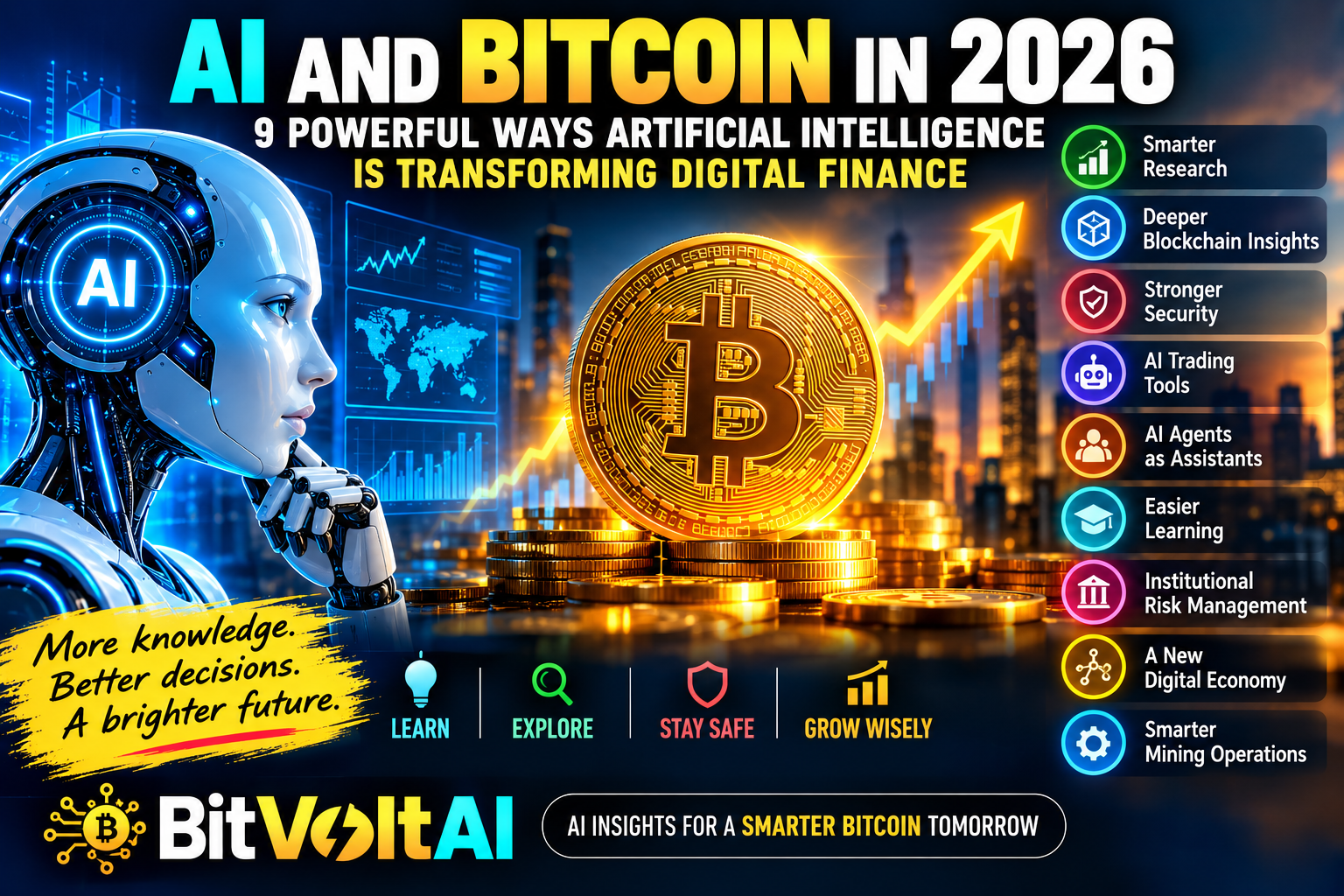
🤖₿ AI Meets Bitcoin in 2026
Artificial intelligence is changing how we research Bitcoin, understand blockchain data, detect scams, strengthen security, manage risk, and explore the future of digital finance.
Discover 9 powerful ways AI and Bitcoin are coming together—and why human judgment still matters in an increasingly automated financial world.
Learn. Explore. Stay Safe. Think Smarter.
— BitVoltAI | AI Insights for a Smarter Bitcoin Tomorrow
🎧 Prefer to Listen? AI and Bitcoin in 2026
Press play and explore how artificial intelligence is transforming the Bitcoin ecosystem—from smarter market research and blockchain analytics to fraud detection, cybersecurity, AI agents, trading technology, mining operations, and digital finance.
This audio edition explains the technology in clear, everyday language while separating genuine AI capabilities from hype and unrealistic promises.
▶️ Listen now and discover where AI and Bitcoin could be heading next.
Educational content only. Not financial or investment advice.
Leave a Reply