Published for BitVoltAI.com
AI Energy Grids 2026 are transforming how the world generates, distributes, and manages electricity. With artificial intelligence optimizing renewable energy, predicting power demand, and preventing outages, intelligent energy infrastructure is becoming one of the most important technological races of the decade.
The modern world runs on electricity.
Every second, billions of people depend on energy for:
- Hospitals
- Banking systems
- Internet infrastructure
- Artificial intelligence
- Transportation
- Communication
- National security
But in 2026, global energy systems are facing unprecedented pressure.
Artificial intelligence is consuming enormous amounts of electricity.
Data centers are expanding rapidly.
Cybersecurity threats are becoming more sophisticated.
And governments worldwide are quietly realizing something alarming:
Traditional power grids may not be prepared for the future.
Now, a new technological revolution is emerging.
Artificial intelligence is increasingly being integrated directly into energy infrastructure itself.
The goal is no longer simply generating electricity.
The goal is building intelligent energy systems capable of:
- Predicting demand
- Detecting cyberattacks
- Preventing outages
- Optimizing energy flow
- Managing renewable power dynamically
Some experts believe AI-driven energy grids may become essential for future civilization.
Others fear the growing dependence on automated infrastructure could create dangerous vulnerabilities and geopolitical instability.
Both perspectives deserve serious attention.
This educational article explores how AI energy grids work, why governments and companies are investing billions into intelligent infrastructure, the emotional anxiety surrounding future energy stability, and why energy security may become one of the defining issues of the digital age.
Contents
- 0.1 What Are AI Energy Grids 2026?
- 0.2 Why AI Energy Grids 2026 Matter for Smart Cities
- 0.3 How AI Energy Grids 2026 Improve Renewable Energy Efficiency
- 0.4 AI Energy Grids 2026 and the Future of Civilization
- 0.5 Benefits and Risks of AI Energy Grids 2026
- 0.6 Frequently Asked Questions About AI Energy Grids 2026
- 1 Why Energy Systems Are Under Extreme Pressure
- 2 What Is an AI Energy Grid?
- 3 Why 2026 Feels Different
- 4 The Emotional Fear Behind Energy Instability
- 5 Educational Example: Traditional Grid vs AI Grid
- 6 Traditional Power Grid
- 7 AI-Enhanced Smart Grid
- 8 Why Cybersecurity Became a Massive Concern
- 9 AI Is Helping Both Defenders and Attackers
- 10 Educational Example: AI Cyberattack Detection
- 11 Why Data Centers Are Becoming Strategic Infrastructure
- 12 The Global Race for Energy Intelligence
- 13 Educational Example: Renewable Energy Management
- 14 Why AI and Energy Are Becoming Deeply Connected
- 15 The Anxiety Around Infrastructure Dependence
- 16 Educational Example: Smart City Infrastructure
- 17 Why Experts Warn Against Blind Automation
- 18 The Rise of AI-Powered Grid Security
- 19 Why Energy Security Is Becoming Geopolitical
- 20 Internal Educational Resources
- 21 External Educational Resources
- 22 Why Emotional Balance Matters
- 23 What Responsible Innovators Usually Understand
- 24 Frequently Asked Questions (FAQ)
- 24.1 What is an AI energy grid?
- 24.2 Why are power grids under pressure?
- 24.3 How does AI help energy systems?
- 24.4 Why is cybersecurity important for smart grids?
- 24.5 Can AI prevent blackouts completely?
- 24.6 Why are governments investing heavily in smart grids?
- 24.7 Are AI systems replacing human operators?
- 24.8 Why does modern infrastructure create anxiety?
- 25 Final Thoughts
What Are AI Energy Grids 2026?
Why AI Energy Grids 2026 Matter for Smart Cities
How AI Energy Grids 2026 Improve Renewable Energy Efficiency
AI Energy Grids 2026 and the Future of Civilization
Benefits and Risks of AI Energy Grids 2026
Frequently Asked Questions About AI Energy Grids 2026
Why Energy Systems Are Under Extreme Pressure
Electricity demand is growing rapidly worldwide.
One major reason is artificial intelligence.
Modern AI systems require:
- Massive data centers
- High-performance computing
- Advanced cooling systems
- Continuous energy supply
According to the International Energy Agency (IEA), electricity demand from AI-focused data centers surged dramatically in 2025, with AI infrastructure becoming one of the fastest-growing energy consumers globally.
This creates enormous stress on aging electrical infrastructure.
What Is an AI Energy Grid?
An AI energy grid is an electricity network that uses artificial intelligence to optimize and protect power systems in real time.
Traditional grids often rely heavily on manual monitoring and slower response systems.
AI-enhanced grids can:
- Predict electricity demand
- Detect abnormalities instantly
- Optimize renewable energy integration
- Monitor infrastructure health
- Improve cybersecurity response
The goal is creating a smarter, more adaptive energy system.
Why 2026 Feels Different
For decades, power grids operated relatively predictably.
Today, multiple technological forces are colliding simultaneously:
- Artificial intelligence
- Renewable energy expansion
- Smart cities
- Electric vehicles
- Climate pressure
- Cybersecurity threats
This creates a far more complicated energy environment.
Experts increasingly believe AI will become critical for managing future grid complexity.
The Emotional Fear Behind Energy Instability
Most people rarely think about power grids until something goes wrong.
But electricity powers nearly every aspect of modern civilization.
Without stable energy:
- Hospitals fail
- Financial systems stop
- Internet services collapse
- Transportation systems struggle
That reality creates growing anxiety among:
- Governments
- Businesses
- Infrastructure planners
- Ordinary citizens
Many people secretly wonder:
“Can modern infrastructure actually handle the future?”
Educational Example: Traditional Grid vs AI Grid
Let’s imagine a realistic educational scenario.
Traditional Power Grid
A heat wave suddenly increases electricity demand.
The traditional grid reacts slowly.
Overloads begin spreading.
Operators struggle to respond fast enough.
Blackout risks increase.
AI-Enhanced Smart Grid
An AI-powered grid detects:
- Rising temperatures
- Demand spikes
- Infrastructure stress
before critical overload occurs.
The system dynamically:
- Reroutes electricity
- Adjusts load balancing
- Activates backup resources
- Reduces outage risks
The difference is not simply automation.
It is intelligent prediction and response.
Why Cybersecurity Became a Massive Concern
As energy grids become more digital, cybersecurity risks increase dramatically.
Modern infrastructure now connects:
- Sensors
- Smart meters
- Automated substations
- AI systems
- Cloud infrastructure
This creates new vulnerabilities.
Researchers increasingly warn that AI-driven cyber threats may target critical infrastructure systems including energy grids.
AI Is Helping Both Defenders and Attackers
One disturbing reality in 2026:
Artificial intelligence is empowering both cybersecurity defenders and cybercriminals.
Attackers increasingly use AI for:
- Automated phishing
- Deepfake impersonation
- Malware generation
- Infrastructure probing
Meanwhile defenders use AI for:
- Threat detection
- Anomaly monitoring
- Real-time security analysis
Experts warn cybersecurity is entering an era of “machine-speed warfare.”
Educational Example: AI Cyberattack Detection
Imagine hackers attempting to infiltrate a smart grid system.
Traditional monitoring may overlook small anomalies.
An AI security system notices:
- Unusual traffic patterns
- Abnormal sensor behavior
- Coordinated attack signals
before human operators fully recognize the threat.
Researchers are already developing AI systems capable of identifying coordinated multi-stage attacks on energy infrastructure.
Why Data Centers Are Becoming Strategic Infrastructure
Modern AI systems require enormous computing power.
That means more:
- Data centers
- Cooling facilities
- Electrical demand
The situation is becoming so serious that energy regulators increasingly warn about grid instability caused by AI infrastructure growth.
Some experts now argue AI infrastructure should be treated as critical national infrastructure similar to water and energy systems.
The Global Race for Energy Intelligence
Countries increasingly understand that future technological leadership may depend on:
- AI infrastructure
- Energy stability
- Cybersecurity resilience
- Smart grid modernization
This has intensified global investment in:
- AI grid systems
- Renewable integration
- Quantum-safe infrastructure
- Intelligent power management
The competition is becoming both technological and geopolitical.
Educational Example: Renewable Energy Management
Renewable energy creates additional complexity.
Solar and wind power fluctuate constantly.
Traditional systems struggle with:
- Prediction accuracy
- Dynamic balancing
- Storage optimization
AI systems increasingly help utilities:
- Forecast renewable generation
- Optimize energy flow
- Reduce waste
- Improve grid stability
Reuters recently reported that AI is becoming central to balancing renewable energy systems and improving grid flexibility worldwide.
Why AI and Energy Are Becoming Deeply Connected
Many people still think of AI as mainly chatbots and automation tools.
But AI increasingly affects physical infrastructure itself.
Modern AI systems now assist with:
- Predictive maintenance
- Grid monitoring
- Equipment diagnostics
- Power forecasting
- Energy efficiency
Industry experts increasingly believe AI will become essential for future utility operations.
The Anxiety Around Infrastructure Dependence
As society becomes more digital, dependence on electricity becomes more intense.
People increasingly worry about:
- Grid failures
- Cyberattacks
- Energy shortages
- AI infrastructure overload
- Technological fragility
These fears are understandable because modern civilization depends heavily on uninterrupted electricity.
The more connected systems become, the more vulnerable they may also become.
Educational Example: Smart City Infrastructure
Imagine a future smart city powered by:
- AI traffic systems
- Automated hospitals
- Electric transportation
- Intelligent energy networks
The city operates efficiently.
But it also becomes highly dependent on:
- Stable electricity
- Secure networks
- Reliable AI systems
This creates both incredible opportunity and serious risk.
Technology often creates both simultaneously.
Why Experts Warn Against Blind Automation
Even advanced AI systems are not perfect.
Researchers emphasize the importance of maintaining “human-in-the-loop” oversight for critical infrastructure.
Why?
Because AI systems can still:
- Misinterpret signals
- React incorrectly
- Create unexpected outcomes
- Become vulnerable to manipulation
Human oversight remains essential.
The Rise of AI-Powered Grid Security
Utilities increasingly deploy AI-driven anomaly detection systems to strengthen infrastructure protection.
Emerging systems focus on:
- Real-time threat detection
- Automated response
- Predictive maintenance
- Infrastructure resilience
This shift is becoming one of the most important developments in modern energy security.
Why Energy Security Is Becoming Geopolitical
Energy infrastructure now influences:
- National security
- Economic stability
- Technological competitiveness
- Military resilience
Recent geopolitical tensions have increased concern about protecting critical digital infrastructure and energy systems.
This is why governments increasingly view energy infrastructure as strategically important.
Internal Educational Resources
Readers interested in advanced technology and infrastructure may also explore:
External Educational Resources
For additional educational learning:
Why Emotional Balance Matters
Constant exposure to:
- Cybersecurity fears
- AI headlines
- Infrastructure concerns
- Economic uncertainty
can emotionally overwhelm people.
Healthy learning habits include:
- Critical thinking
- Avoiding panic
- Studying carefully
- Maintaining realistic expectations
Technology should strengthen society — not create constant emotional fear.
What Responsible Innovators Usually Understand
Long-term infrastructure development requires:
- Patience
- Security planning
- Ethical responsibility
- Human oversight
- Sustainable growth
The future energy system will likely involve cooperation between:
- AI systems
- Human experts
- Governments
- Engineers
- Cybersecurity teams
No technology alone solves every problem.
AI Energy Grids 2026 are not only about faster electricity delivery; they are about building safer, cleaner, and more reliable power systems for modern society.
For smart cities, AI Energy Grids 2026 can help balance solar energy, wind power, battery storage, and consumer demand in real time.
One major advantage of AI Energy Grids 2026 is predictive maintenance, where AI detects grid problems before they cause large-scale outages.
In the coming years, AI Energy Grids 2026 may become a foundation for sustainable development, energy security, and intelligent urban growth.
Frequently Asked Questions (FAQ)
What is an AI energy grid?
An AI energy grid uses artificial intelligence to optimize, monitor, and protect electricity infrastructure in real time.
Why are power grids under pressure?
Growing AI infrastructure, data centers, renewable energy complexity, and rising electricity demand are increasing pressure on modern grids.
How does AI help energy systems?
AI can help with:
- Demand forecasting
- Grid balancing
- Predictive maintenance
- Cybersecurity monitoring
- Renewable energy optimization
Why is cybersecurity important for smart grids?
Modern grids are increasingly digital and connected, creating new vulnerabilities to cyberattacks.
Can AI prevent blackouts completely?
No system is perfect, but AI may help reduce outage risks by improving prediction and response speed.
Why are governments investing heavily in smart grids?
Energy infrastructure influences economic stability, national security, and technological competitiveness.
Are AI systems replacing human operators?
Most experts recommend AI as a decision-support tool rather than fully autonomous infrastructure control.
Why does modern infrastructure create anxiety?
People increasingly worry about energy dependence, cybersecurity risks, and the growing complexity of digital systems.
Final Thoughts
AI energy grids may become one of the most important technological transformations of the modern era.
They represent:
- Smarter infrastructure
- Faster response systems
- Better renewable integration
- Improved energy efficiency
- Advanced cybersecurity protection
At the same time, they also raise:
- Ethical questions
- Security concerns
- Emotional uncertainty
- Infrastructure dependency risks
Some people will fear these developments completely.
Others will blindly trust automation.
But the people most likely to adapt successfully may be those who:
- Stay educated
- Think critically
- Respect cybersecurity risks
- Avoid emotional extremes
- Continue learning consistently
Artificial intelligence is powerful.
Energy infrastructure is powerful.
Future smart grids may become even more powerful.
But human wisdom, responsibility, and emotional discipline remain the most important systems of all.
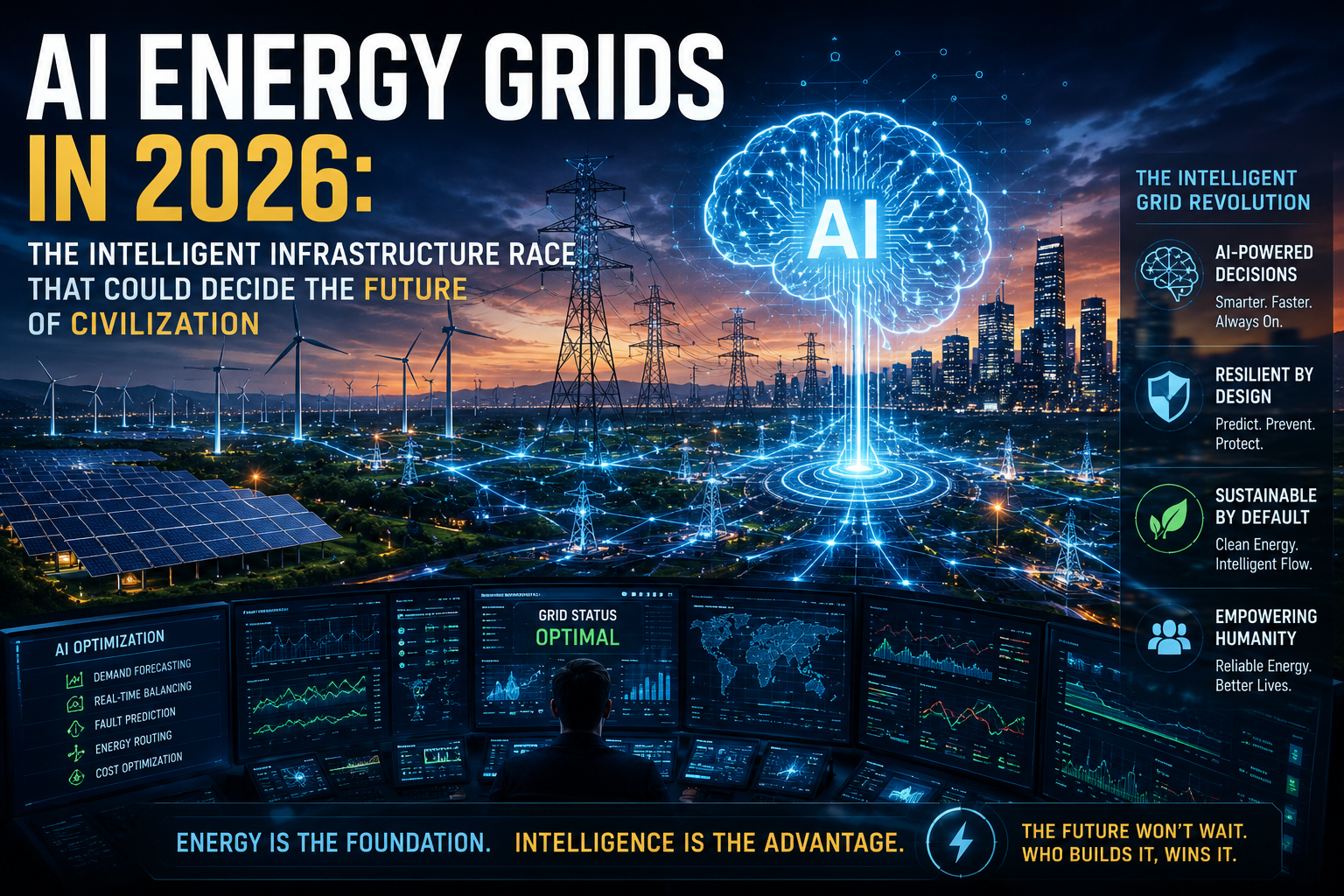
⚡ AI Energy Grids in 2026 are transforming the future of electricity, cybersecurity, and smart infrastructure.
From AI-powered smart grids to renewable energy optimization and cyber defense systems, intelligent energy networks are becoming one of the most important technologies of the modern era.
But as civilization becomes more dependent on automated infrastructure, critical questions emerge about security, resilience, and the future stability of global power systems.
Listen now to explore how artificial intelligence is reshaping the energy industry and why the intelligent infrastructure race could define the future of civilization.
🎧 Educational • Futuristic • Human-Centered
#AIEnergyGrids #ArtificialIntelligence #SmartGrid #RenewableEnergy #Cybersecurity #FutureTechnology #EnergyInfrastructure #BitVoltAI
⚡ AI Energy Grids in 2026 are transforming the future of civilization. From smart cities to self-healing power networks, Artificial Intelligence is reshaping how the world generates, stores, and distributes energy. 🌍🔋
In this educational video, discover how AI-driven infrastructure could reduce blackouts, improve renewable energy efficiency, and power the next generation of intelligent societies.
🚀 The global race for intelligent energy systems has already begun.
#AIEnergyGrids #ArtificialIntelligence #SmartGrid #FutureTechnology #RenewableEnergy #EnergyInnovation #BitVoltAI #AITechnology #FutureOfEnergy #SmartCities