Contents
- 1 Introduction: A New Era of Financial Intelligence
- 2 AI Crypto Trading 2026: A New Era of Intelligent Investing
- 3 Why AI Crypto Trading 2026 is Dominating Markets
- 4 Key Components of AI Crypto Trading 2026 Systems
- 5 Risk Management in AI Crypto Trading 2026
- 6 Benefits of AI Crypto Trading 2026 for Investors
- 7 Popular AI Trading Approaches
- 8 Risk Management: A Non-Negotiable Principle
- 9 Human Judgment vs. Machine Intelligence
- 10 Common Misconceptions About AI Trading
- 11 Steps to Begin Learning AI Crypto Trading
- 12 Ethical and Regulatory Considerations
- 13 The Future of AI in Crypto Markets
- 14 Conclusion: A Balanced Perspective
- 15 Final Thought
Introduction: A New Era of Financial Intelligence
AI Crypto Trading 2026: A New Era of Intelligent Investing
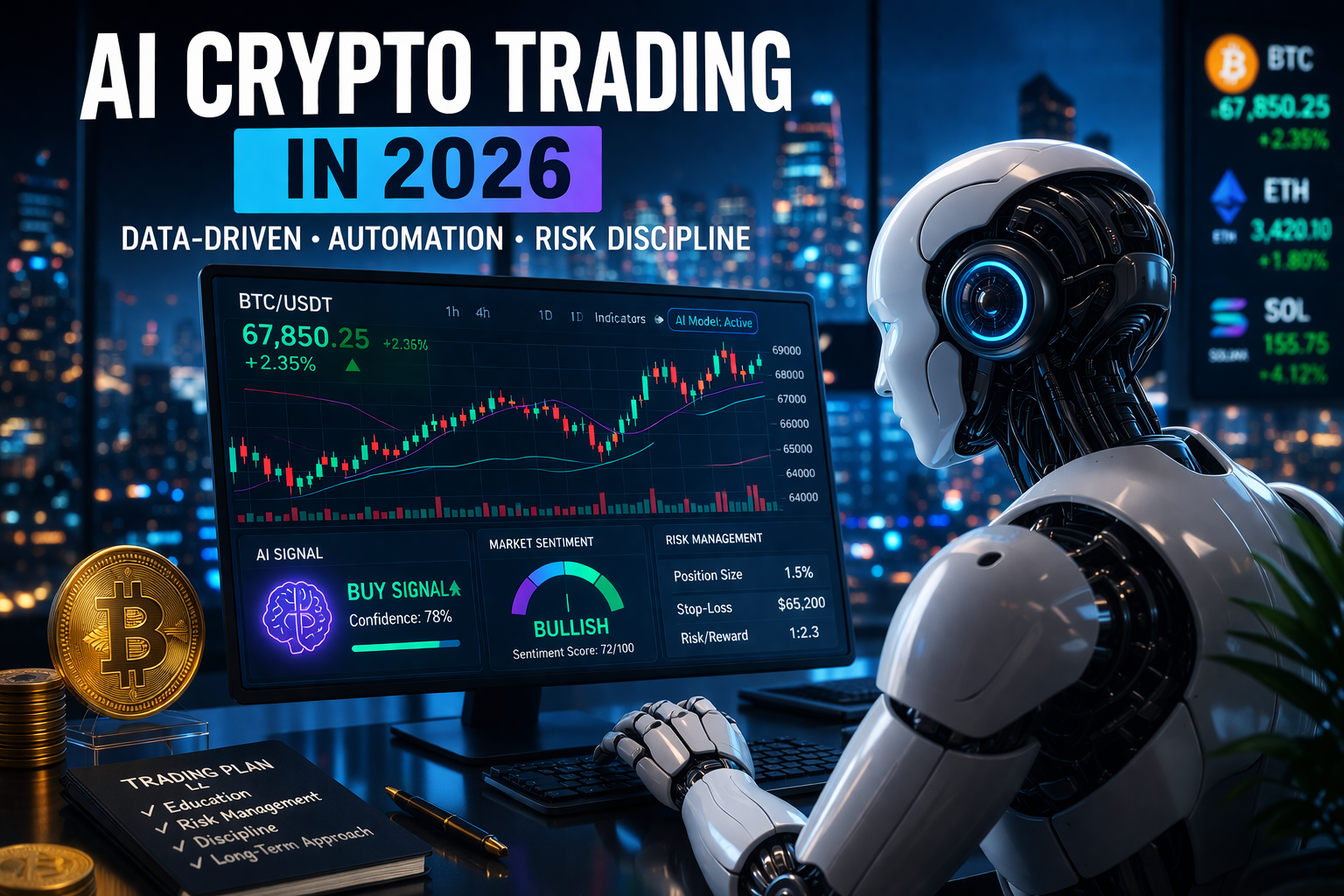
AI Crypto Trading 2026 represents a major transformation in how modern financial markets operate. With over two decades of experience observing market evolution, it is clear that artificial intelligence is no longer optional—it is becoming a core component of successful trading strategies.
In 2026, cryptocurrency markets are driven by speed, data, and automation. Traditional trading methods are increasingly insufficient in handling the complexity and volatility of digital assets. AI-powered systems now assist traders in analyzing vast datasets, identifying patterns, and executing trades with precision.
Having observed financial markets over the past twenty-five years—from traditional equities and commodities to the emergence of cryptocurrencies—I can confidently state that we are witnessing one of the most transformative phases in trading history. The integration of Artificial Intelligence (AI) into cryptocurrency markets represents not just a technological upgrade, but a fundamental shift in how decisions are made.
In earlier decades, trading success relied heavily on experience, intuition, and manual analysis. Today, those elements remain important, but they are now supported by powerful computational systems capable of analyzing vast datasets in real time. In 2026, AI-driven crypto trading has moved from experimental adoption to mainstream relevance.
This article aims to provide a clear, structured, and educational understanding of how AI is shaping crypto trading, while emphasizing the importance of discipline, risk management, and informed decision-making.
Why AI Crypto Trading 2026 is Dominating Markets
Artificial Intelligence in trading refers to systems designed to simulate human intelligence while processing significantly larger volumes of data. In the context of cryptocurrency markets, AI systems perform several key functions:
- Analyze historical price data
- Monitor live market movements
- Evaluate trading volumes and liquidity
- Interpret sentiment from news and social platforms
- Execute trades based on predefined rules
Unlike traditional tools, AI systems continuously learn and adapt. This adaptability is crucial in crypto markets, where volatility is not an exception but a defining characteristic.
Key Components of AI Crypto Trading 2026 Systems
Cryptocurrency markets differ from traditional financial markets in several ways:
1. Continuous Operation
Crypto markets operate 24 hours a day, seven days a week. This continuous activity makes it impossible for human traders to monitor markets at all times without fatigue.
2. High Volatility
Price fluctuations in cryptocurrencies can be extreme. Significant movements can occur within minutes, requiring rapid response mechanisms.
3. Fragmented Market Structure
Unlike centralized exchanges in traditional finance, crypto trading occurs across multiple platforms globally. Price discrepancies and liquidity differences are common.
4. Influence of Non-Traditional Factors
Social media sentiment, technological developments, and regulatory announcements often have immediate and profound effects on prices.
AI systems are particularly well-suited to navigate these complexities due to their speed, scalability, and analytical capabilities.
Risk Management in AI Crypto Trading 2026
To understand AI trading effectively, it is important to break it down into its core components.
1. Data Collection and Processing
AI systems rely on extensive datasets, including:
- Historical price charts
- Order book data
- Trading volumes
- Blockchain transaction data
- News and social media inputs
The ability to process structured and unstructured data simultaneously is a key advantage.
2. Machine Learning Models
Machine learning allows systems to:
- Identify patterns in historical data
- Predict potential market movements
- Continuously improve based on new information
These models are not static. They evolve as market conditions change.
3. Algorithmic Execution
Once a decision is made, execution speed becomes critical. AI-powered algorithms can:
- Enter and exit positions instantly
- Adjust strategies dynamically
- Minimize slippage and transaction costs
4. Risk Management Framework
From decades of experience, I can assert that risk management is the cornerstone of sustainable trading. AI systems incorporate risk controls such as:
- Position sizing
- Stop-loss mechanisms
- Portfolio diversification
- Drawdown limits
Without these safeguards, even the most advanced systems can lead to significant losses.
Benefits of AI Crypto Trading 2026 for Investors
In traditional trading, data analysis was often limited by human capacity. Today, AI systems can analyze millions of data points in seconds.
Types of Data Used
- Technical Data: Price trends, indicators, chart patterns
- Fundamental Data: Project developments, partnerships, adoption metrics
- On-Chain Data: Wallet movements, transaction volumes
- Sentiment Data: Public opinion extracted from news and social platforms
The integration of these data sources allows for a more comprehensive understanding of market behavior.
Popular AI Trading Approaches
AI trading does not rely on a single method. Instead, it employs a combination of strategies.
1. Trend Analysis
Identifying and following market trends remains one of the most effective approaches. AI enhances this by detecting trends earlier and with greater accuracy.
2. Mean Reversion
This strategy assumes that prices will revert to their average over time. AI systems can identify deviations and execute trades accordingly.
3. Arbitrage Opportunities
Price differences between exchanges can be exploited for profit. AI systems can detect and act on these opportunities within seconds.
4. Sentiment-Based Trading
By analyzing public sentiment, AI can anticipate market reactions before they fully materialize.
Risk Management: A Non-Negotiable Principle
In my experience, many traders focus excessively on profit potential while neglecting risk control. This imbalance often leads to failure.
Key Principles of Risk Management
- Allocate only a small percentage of capital per trade
- Avoid excessive leverage
- Maintain diversification across assets
- Implement strict stop-loss rules
- Regularly review and adjust strategies
AI systems can enforce these principles consistently, reducing the likelihood of emotional decision-making.
Human Judgment vs. Machine Intelligence
While AI offers significant advantages, it is important to recognize its limitations.
Strengths of AI
- Speed and efficiency
- Data processing capability
- Consistency in execution
Limitations of AI
- Dependence on data quality
- Vulnerability to unexpected events
- Lack of contextual understanding
Human oversight remains essential. The most effective approach is a balanced integration of human insight and machine efficiency.
Common Misconceptions About AI Trading
Over the years, I have observed several misconceptions that can mislead new participants:
“AI Guarantees Profits”
No system can eliminate risk entirely. AI improves probability, not certainty.
“Automation Means No Supervision”
Even automated systems require monitoring and periodic adjustments.
“More Complexity Equals Better Results”
Simplicity and clarity often lead to more reliable outcomes than overly complex models.
Steps to Begin Learning AI Crypto Trading
For those interested in exploring this field, a structured approach is essential.
Step 1: Build Foundational Knowledge
Understand:
- Blockchain technology
- Market structure
- Basic trading principles
Step 2: Learn Data Interpretation
Develop skills in:
- Technical analysis
- Data visualization
- Pattern recognition
Step 3: Explore AI Concepts
Familiarize yourself with:
- Machine learning basics
- Algorithmic trading frameworks
- Data-driven decision-making
Step 4: Practice in Simulated Environments
Before committing real capital, test strategies in controlled environments.
Step 5: Maintain Discipline
Consistency and patience are more valuable than short-term gains.
Ethical and Regulatory Considerations
As AI becomes more prevalent, regulatory frameworks are evolving. Traders must remain aware of:
- Compliance requirements
- Tax implications
- Ethical use of automated systems
Transparency and accountability are essential in maintaining trust within the ecosystem.
🔗 https://bitvoltai.com/ai-crypto-risk-management-2026
🔗 https://bitvoltai.com/crypto-market-volatility-2026
The Future of AI in Crypto Markets
Looking ahead, several trends are likely to shape the future:
1. Increased Integration with Advanced Technologies
AI may combine with emerging fields such as quantum computing and advanced analytics.
2. Greater Accessibility
Tools and platforms will become more user-friendly, allowing broader participation.
3. Enhanced Predictive Accuracy
Continuous improvements in data quality and modeling techniques will refine forecasting capabilities.
- https://www.investopedia.com/cryptocurrency-4427699
- https://coinmarketcap.com/
- https://www.binance.com/en/learn
Conclusion: A Balanced Perspective
AI crypto trading represents a powerful evolution in financial markets. However, it is not a shortcut to success. It is a tool—one that must be used with knowledge, discipline, and caution.
From a long-term perspective, sustainable success in trading depends on:
- Continuous learning
- Effective risk management
- Emotional discipline
- Adaptability to changing conditions
Technology may evolve, but these foundational principles remain constant.
Final Thought
In all my years of observing financial markets, one lesson stands above all:
Markets reward those who respect risk, remain patient, and commit to continuous improvement.
AI can enhance your capabilities, but it is your understanding and discipline that ultimately determine your success.
Leave a Reply